Why Extreme Temperature and Clean Atmosphere Processing Matters
As modern materials science continues to push the boundaries of thermodynamics, researchers frequently encounter challenges that conventional laboratory furnaces cannot adequately address. Today’s advanced materials research seeks ambitious goals, including the discovery of new phases such as ternary diborides, achieving precise lattice structures in battery-grade graphite, and managing the molten state of refractory metals and ceramics for accurate compositional tuning. These objectives impose demanding laboratory requirements:
- Temperatures beyond 2,500 °C, surpassing conventional resistive heating elements.
- Clean, contamination-free atmospheres, devoid of oxygen and hydrogen to prevent volatilization, decarburization, and nitrogen pickup.
- Rapid thermal cycling with precise temperature control, enabling experiments to conclude in hours rather than days.
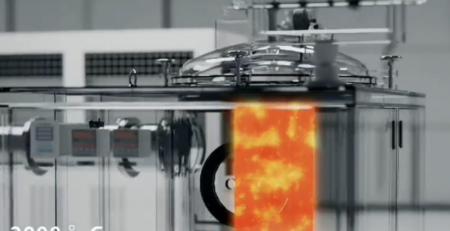
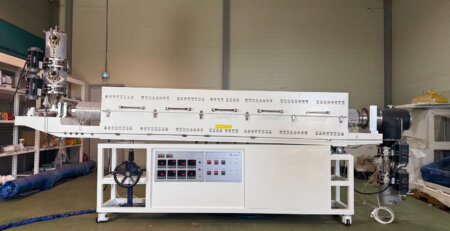
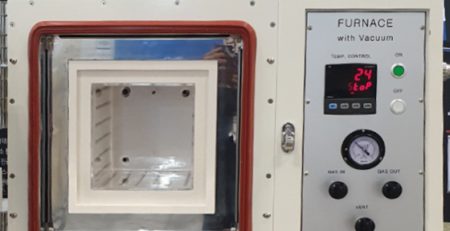
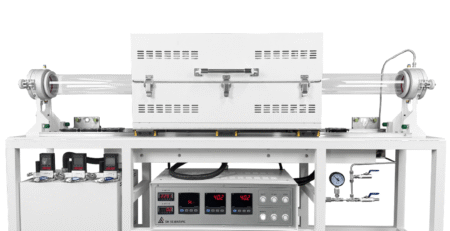
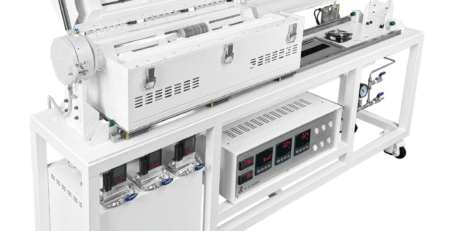
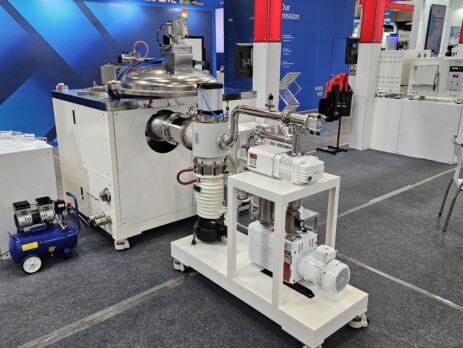
Induction furnaces address these challenges effectively by heating materials indirectly using electromagnetic induction. Eddy currents generated in a graphite susceptor eliminate consumable heating elements and combustion impurities, fulfilling critical laboratory demands. The SH Scientific SH-FU-35MS3000, a 2,800 °C vacuum induction furnace with programmable PLC controls, a three-stage vacuum system (rotary, Roots, diffusion pumps), and closed-loop water cooling, exemplifies this capability. It provides laboratories with a turnkey solution for ultra-high temperature environments under vacuum or inert gas conditions.









Sector-Specific Challenges and the Role of a 2,800 °C Vacuum Induction Furnace
High-temperature induction furnaces uniquely address scientific and industrial challenges across diverse sectors. Here is how a 2,800 °C vacuum induction furnace serves critical fields:
Advanced Carbon and Graphite Materials
Achieving full graphitization, with interlayer spacing approaching 0.335 nm, in materials such as carbon fibers and graphite anodes requires temperatures from 2,700 to 2,900 °C. Research confirms substantial improvements in lattice ordering and mechanical properties at these temperatures. A sealed induction heating environment prevents oxidation and alkali contamination, essential for battery-grade graphite production.
Ultra High Temperature Ceramics (UHTCs)
Materials such as zirconium diboride (ZrB₂), hafnium carbide (HfC), and tantalum carbide (TaC) require sintering above 2,400 °C under oxygen-free atmospheres, particularly for hypersonic and fusion energy applications. Recent studies indicate optimal densification at 2,500 to 2,760 °C. Induction furnaces precisely control inert atmospheres and temperature, allowing rapid experimentation without frequent rebuilds of the heating zone.
Superalloys and Refractory Metals
Aerospace and nuclear industries rely heavily on small-batch melting of nickel, cobalt, and molybdenum alloys, demanding impurity levels below single-digit ppm for oxygen, nitrogen, and sulfur. Vacuum induction melting (VIM) has been the preferred method for these alloys since the 1960s. The SH-FU-35MS3000’s 35-liter hot zone accommodates laboratory-scale melts while maintaining stringent purity requirements, facilitating alloy development and directional solidification research.
Powder Metallurgy and Additive Manufacturing Feedstocks
Vacuum induction melting forms the foundational step in producing high-quality metallic powders through inert-gas atomization processes (VIM-IGA/VIGA). The purity and precise chemical composition of these feedstocks directly influence the mechanical properties and fatigue life of additive-manufactured components. Laboratory-scale induction furnaces allow rapid prototyping of novel alloy compositions, enabling efficient transition from lab research to industrial-scale production.
High Melting Point Crystal Growth
The development of new optical crystals and eutectic materials requires temperatures beyond standard sapphire and YAG crystal growth methods (typically around 2,100 °C). A 2,800 °C vacuum induction furnace offers a versatile testing platform for new crucible materials, melt chemistries, and crystal growth procedures, before scaling to specialized industrial crystal-growth equipment.
Innovative Design Features Enhancing Research Quality and Reliability
Several design features of ultra high temperature induction furnaces, demonstrated by the SH-FU-35MS3000, directly enhance research outcomes:
Rapid Thermal Cycling
Heating rates of over 20 °C per minute significantly reduce experimental time, minimize grain growth, and ensure accurate data for diffusion-driven phase studies and nano-reinforced composite research.
Multi-Zone Vacuum Monitoring
Independent gauges monitor vacuum conditions, quickly identifying sensor drift or pump degradation before compromising data quality.
360° Swivel Human Machine Interface (HMI) and PLC Stored Recipes
This reduces operator variability, ensuring consistent thermal profiles even in multi-user laboratory environments.
Closed Loop Water Cooling
This environmentally friendly system removes the need for single-use water supplies, simplifying laboratory installation and enabling safe operation within standard fume hoods.
These advanced features align closely with standard risk mitigation practices in high-temperature research, emphasizing redundancy, traceability, and facility independence.
Lifecycle and Laboratory Scalability
Induction furnaces inherently reduce lifecycle costs by eliminating consumable heating elements that typically fail under repeated extreme temperature conditions. Maintenance requirements are minimal, usually restricted to annual replacements of diffusion pump oil and cooling water filters.
Additionally, the SH-FU-35MS3000’s 35-liter hot-zone capacity (300 mm diameter by 500 mm height) achieves a balance between experimental versatility and ease of laboratory integration. It accommodates kilogram-scale melts and standard crystal-growth crucibles, yet remains compact enough to operate from a typical 50 Amp laboratory power panel. This design makes it ideal for academic laboratories, research institutes, and industrial R&D centers seeking advanced capabilities without extensive infrastructure modifications.
A New Foundation for Advancing Materials Science Research
Across various sectors, including advanced battery anodes, hypersonic ceramics, clean superalloys, additive manufacturing powders, and crystal growth, the primary research bottleneck is rarely analytical instrumentation. Instead, the limitation usually lies in the absence of laboratory furnaces capable of reliably replicating industrial thermal and atmospheric conditions.
Vacuum induction furnaces capable of stable operation at temperatures up to 2,800 °C, exemplified by SH Scientific’s SH-FU-35MS3000, effectively address this critical gap. With precise temperature control, inert or vacuum atmospheres, rapid thermal cycling capabilities, and automated safety controls, these furnaces facilitate contamination-free and reproducible experimentation. The resulting data are robust, publishable, and directly transferable to industrial contexts.
Today, ultra high temperature vacuum induction furnaces have evolved beyond niche equipment and now represent essential research tools. They provide a practical bridge between exploratory research and industrial-scale applications, empowering laboratories to push the frontiers of materials science forward.