
SH Scientific’s tube furnaces incorporate decades of feedback from commercial and research partners.
Each model features easy, hinged access and a maximum temperature of either 1200°C, 1500°C, 1800°C, or 1900°C. Several controller specs, tube materials, and hot zone configurations are available.
From economical general-purpose models to ultra-high-temperature furnaces, all equipment is subject to the same rigorous inspection and quality control processes.
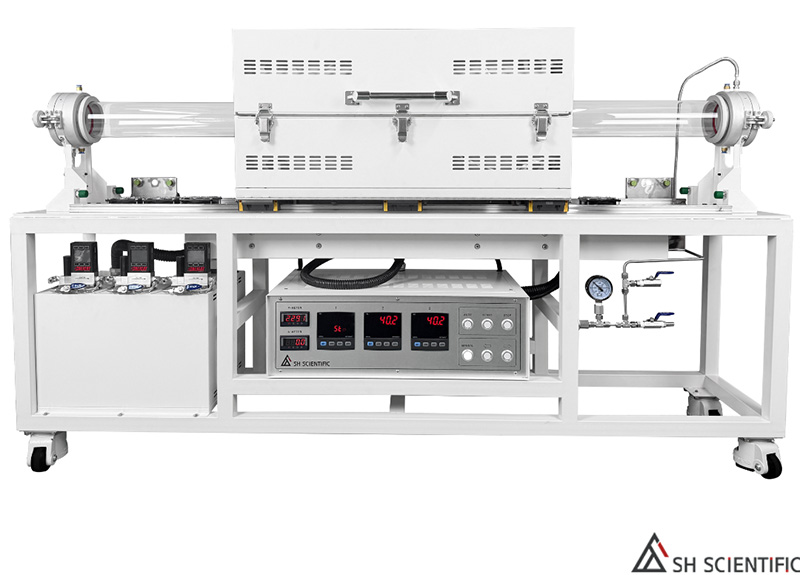
Most models can also be equipped with a gas supply system, vacuum pump, and chiller for complete atmospheric control.
What’s New in 2026?
Introducing the 2026 RTCVD Series: Our new automated instant heating and rapid cooling system delivers unmatched annealing consistency while eliminating process delays. Engineered to be far more cost-effective than traditional lamp-based systems, the RTCVD offers semiconductor R&D centers a faster, more reliable path to precision results.
Learn More
Our Clients


















Tube furnace specifications
Configuration and specification questions for stationary tube furnaces.
What tube diameters are available for SH Scientific tube furnaces?
Process tubes run from 30 mm outside diameter on the mini series up to 274 mm, with 50, 80, 100, 120, 200, and 250 mm as the standard steps in between. The widest choice sits in the SH Scientific 1200°C range, while the 1800°C range spans 50 to 274 mm. Larger diameters shift the trade-off toward capacity and away from heat-up speed and radial uniformity.
What is the difference between the tube furnace only, gas supply, and turnkey vacuum configurations?
These are three purchase tiers of the same furnace body. Tube furnace only is the heated chamber and controller, suited to processing in air. The gas supply configuration adds sealed end fittings and gas flow control for inert or reactive atmospheres. The SH Scientific turnkey vacuum system adds a vacuum pump, gauges, back pressure regulation, and a recirculating chiller, so atmosphere control arrives pre-matched rather than assembled from separate parts.
When should I choose a 3-zone tube furnace over single-zone?
Choose three zones when the process needs a longer uniform region than one hot zone provides, or when different sections of the tube must sit at different temperatures. SH Scientific offers 3-zone models at 1200°C across 50, 80, 100, 120, 200, and 250 mm tube diameters. Single-zone models cover every temperature tier, so this choice is about profile control rather than maximum temperature.
What vacuum level can a tube furnace reach, and which pump is required?
Rotary vane pump packages reach the 10^-6 Torr range and turbomolecular packages reach 10^-7 Torr, including an oil-free option where hydrocarbon backstreaming would contaminate the process. A high-speed 10^-6 variant is available where pump-down time matters more than ultimate pressure. Specify the target pressure before the furnace, because sealing design, gauge selection, and chiller capacity all follow from it.
What wafer sizes do the wafer processing tube furnaces handle?
SH Scientific wafer processing tube furnaces are configured for 2-inch, 3-inch, 6-inch, and 8-inch wafers. The 3-inch and 6-inch sizes are also offered as complete oxidation, diffusion, and annealing packages rather than furnace-only builds. Wafer capacity follows tube diameter, so the practical question is usually how many wafers are needed per run alongside the maximum wafer size.
What is included in a turnkey vacuum tube furnace system?
A turnkey SH Scientific system pairs the furnace and controller with a vacuum pump, vacuum gauge, sealed end fittings, gas flow control, back pressure regulation, and a recirculating chiller. Buying it as one package means pump capacity, seal rating, and chiller duty are matched to the furnace rather than estimated separately, which is where self-assembled systems most often lose vacuum performance.
How are samples loaded into a tube furnace?
Samples sit in boats or crucibles that slide into the process tube, and every SH Scientific model uses hinged access so the furnace opens without unbolting the shell. For sealed work the tube ends carry removable fittings that hold the atmosphere while still allowing access between runs. Loading depth matters as much as sample size, because the sample should sit within the uniform section of the hot zone.