
Tube Furnace Applications & Industries
Stationary controlled-atmosphere processing
Tube Furnace Systems by Application and Industry
A stationary tube furnace heats samples, boats, wafers, and substrates precisely without movement, from general research units to turn-key vacuum and CVD systems.
Tube Furnace means stationary systems. For tumbling powder, see batch rotary furnaces.
By application
Controlled-atmosphere heat treatment
Anneal, sinter, or calcine under inert gas, reactive gas, or vacuum.
CVD and thin-film processing
Gas delivery, vacuum, and thermal profiles for deposition and synthesis.
Wafer oxidation and diffusion
Clean, stable hot zones for oxidation, doping, annealing, and LPCVD.
Materials synthesis and R&D
Repeatable temperature programs for screening and scale-up studies.
Battery and energy materials
Cathode, anode, electrolyte, and carbon development under managed atmosphere.
Vacuum and atmosphere-sensitive work
A sealed tube with pumps, gas supply, and monitoring for reactive materials.
By industry
Semiconductor and electronics
Wafer oxidation, diffusion, LPCVD, annealing, and crystal growth.
Battery and clean energy
Cathode, anode, hydrogen, fuel-cell, and energy-storage development.
Materials science and nanotechnology
Controlled synthesis, coating, and phase-development workflows.
Metals and advanced manufacturing
Annealing, reduction, brazing, and atmosphere-sensitive heat treatment.
Ceramics, glass, and minerals
Sintering, calcination, and high-temperature formulation research.
Academic and government labs
Instruction, shared facilities, and custom experimental work.
Configurations
-
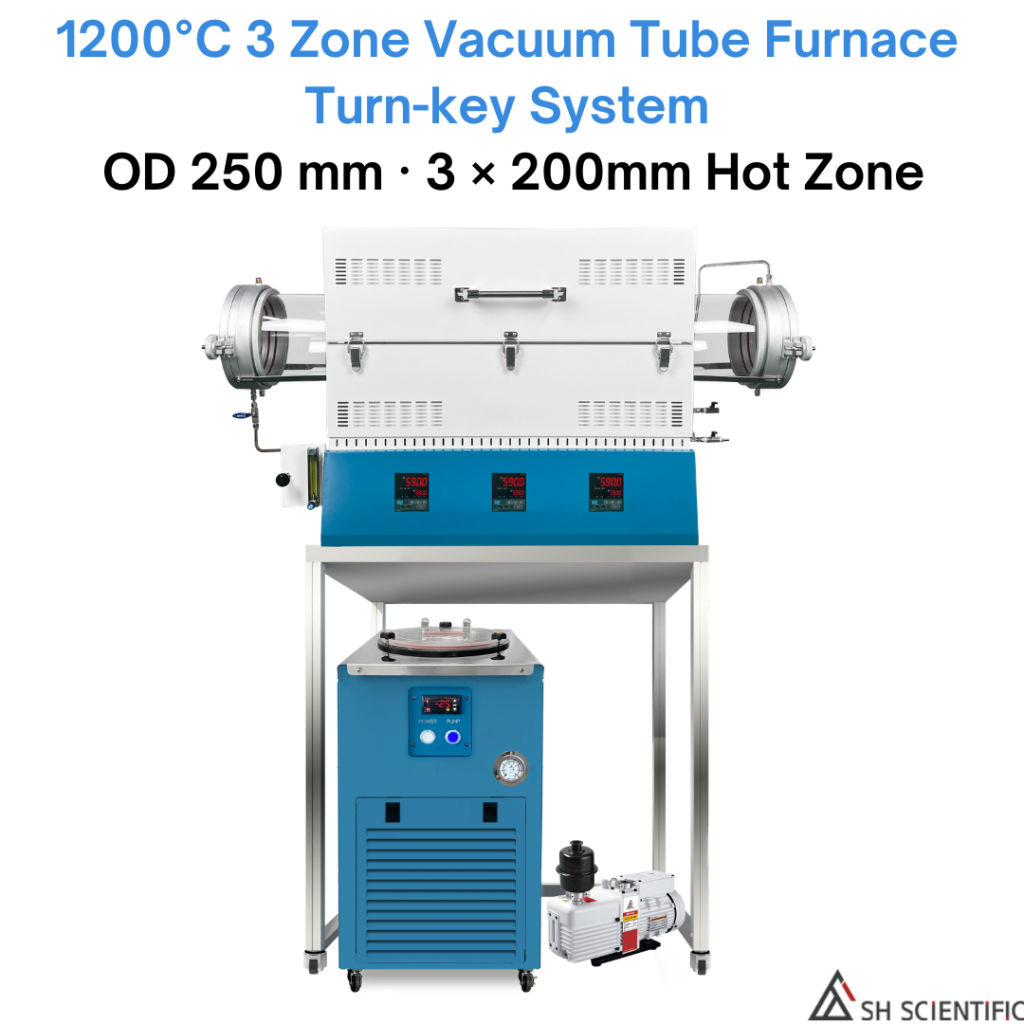
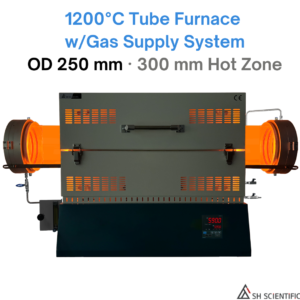
 Tube furnace with gas supply
Turn-key flow control for inert or reactive atmospheres.
Tube furnace with gas supply
Turn-key flow control for inert or reactive atmospheres.
-
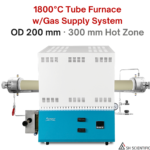
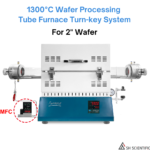
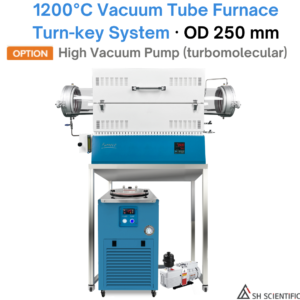
 Turn-key vacuum tube furnace
Integrated furnace, vacuum hardware, gas handling, and controls.
Turn-key vacuum tube furnace
Integrated furnace, vacuum hardware, gas handling, and controls.
-
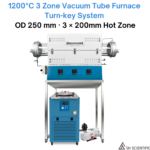
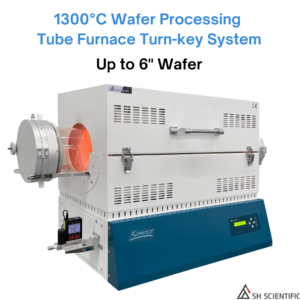
 Wafer oxidation and diffusion
Built for semiconductor thermal processing and LPCVD research.
Wafer oxidation and diffusion
Built for semiconductor thermal processing and LPCVD research.
-
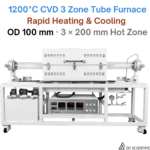 Rapid thermal CVD furnaces
Fast thermal response and multi-zone control for advanced CVD.
Rapid thermal CVD furnaces
Fast thermal response and multi-zone control for advanced CVD.
Resources
Questions
What is a tube furnace best used for?
Controlled-atmosphere heat treatment, materials synthesis, chemical vapor deposition, wafer oxidation and diffusion, annealing, and calcination, meaning any process where the sample stays stationary in a precisely controlled hot zone. SH Scientific tube furnaces suit boats, wafers, substrates, crucibles, and shallow powder beds. Where the material is free-flowing powder that benefits from tumbling, a rotary furnace is the better platform.
How do I choose between a tube furnace and a rotary furnace?
Choose a stationary tube furnace for boats, wafers, substrates, or any fixed sample that must not move during the cycle. Choose a batch rotary furnace when free-flowing powder needs tumbling for even heat exposure and gas contact. The deciding question is whether the sample benefits from being mixed while it is heated: substrates do not, deeper powder beds usually do. SH Scientific builds both families, so the choice is about process fit rather than availability.
Can a tube furnace run under vacuum or gas?
Yes, SH Scientific turn-key tube furnace systems can include sealed end fittings, mass flow or ball-type gas control, vacuum pumps, gauges, back pressure regulation, and a recirculating chiller, selected around the process. Configurations run from simple inert gas purging through to high vacuum with dedicated turbomolecular pump packages. Specify the required vacuum level and gas chemistry together, because sealing design and pump selection both follow from them.
What temperature ranges are available for SH Scientific tube furnaces?
SH Scientific tube furnaces are configured from approximately 1200°C to 1900°C, depending on tube material, heating element, and system design. Lower ranges typically use quartz tubes, while higher ranges move to alumina with MoSi2 elements. Maximum temperature is only part of the selection, because sustained operation near the top of any range shortens element and tube life, so most processes are specified with headroom.
Can SH Scientific build a custom tube furnace system?
Yes, hot-zone length, tube dimensions, atmosphere control, vacuum level, zone count, and controls can all be configured around the application. SH Scientific manufactures in-house, which makes one-off geometry, unusual tube materials, and integrated gas or exhaust handling practical rather than exceptional. Custom work is most often driven by sample geometry or atmosphere requirements rather than by temperature alone.
Tell us the material, batch size, temperature, and atmosphere. Our team will recommend a configuration.
Request a quote