
Rotary Furnace Applications & Industries
Batch powder processing
Rotary Furnace Systems by Application and Industry
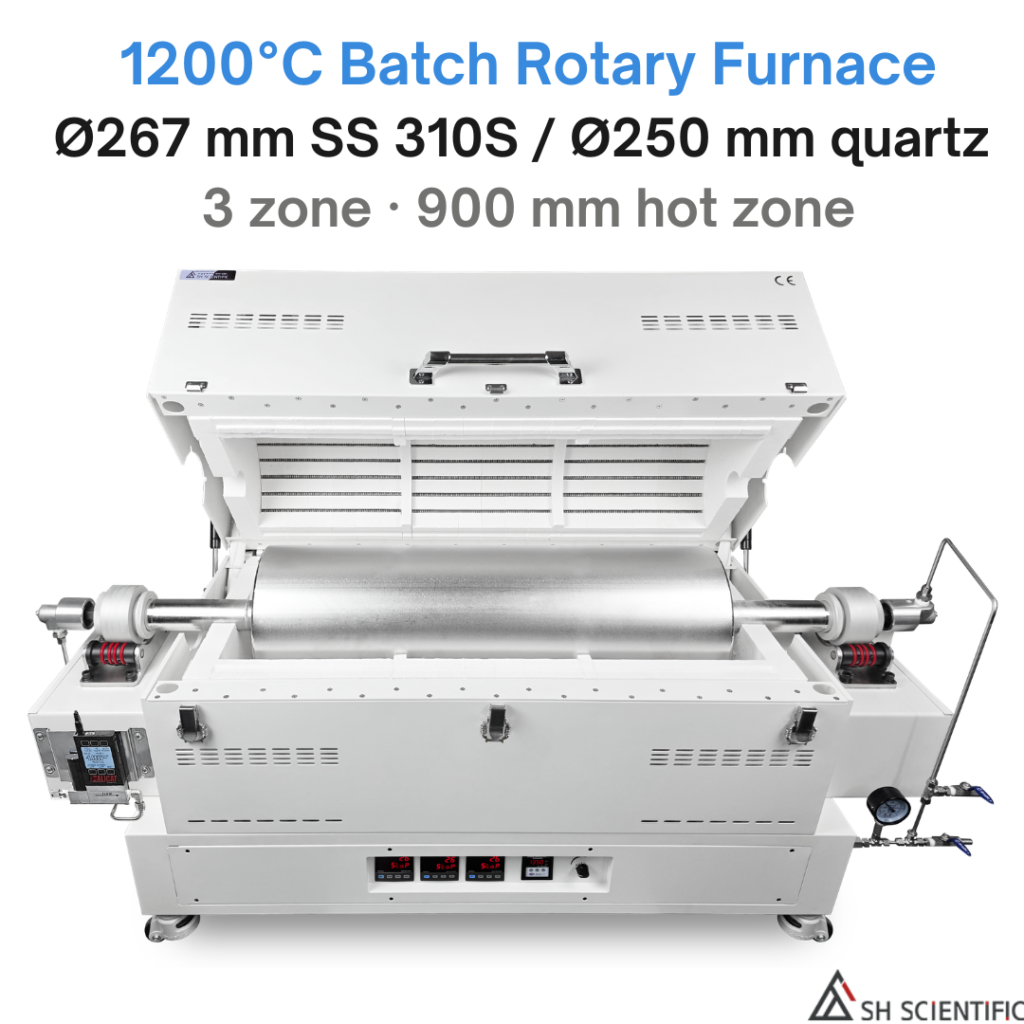
A batch rotary tube furnace keeps powder moving through the hot zone, which improves heat exposure, gas contact, and repeatability.
Rotary Furnace means batch systems for powder. For fixed samples, see stationary tube furnaces.
By application
Powder calcination
Uniform decomposition and phase conversion with less local overheating and caking.
Reduction and gas-solid reactions
Particles stay in motion through hydrogen, syngas, or inert atmospheres.
Sintering and thermal treatment
Controlled profiles for free-flowing powders that benefit from tumbling.
Coating, activation, carbonization
Better particle movement and gas contact during activation and pyrolysis.
By industry
Battery and energy materials
Cathode and anode precursor calcination and conductive carbon treatment.
Catalysts and specialty chemicals
Calcination, activation, drying, and controlled-atmosphere treatment.
Mining, metallurgy, recycling
Lab-scale reduction and upgrading studies for ores and recovered material.
Ceramics and advanced materials
Repeatable processing for ceramic powders and technical minerals.
Carbon and environmental materials
Carbonization and activation for biomass and waste-derived powders.
Universities and R&D labs
Screening recipes, comparing atmospheres, and generating scale-up data.

Resources
Questions
How is a rotary furnace different from a stationary tube furnace?
A rotary furnace turns the process tube so powder tumbles continuously through the heated zone, which repeatedly exposes fresh particle surfaces to both heat and process gas. A stationary tube furnace holds the sample still, which suits boats, wafers, substrates, and any process where movement would disturb the sample. The practical test is whether the material is free-flowing powder that benefits from mixing, or a fixed object that needs to stay in place.
Why does the SH Scientific batch rotary tube furnace have no tilt?
SH Scientific fixed the batch rotary tube furnace horizontally after research institutions reported that tilt added mechanical complexity without benefit for nanotubes and fine powders. With no tilt, material stays in the hot zone for the full programmed cycle instead of migrating toward the discharge end, so the entire charge sees the same thermal history. It also simplifies recovery, because the tube can be withdrawn and emptied without chasing material that has drifted out of the heated region.
What tube sizes and working volumes are available in a batch rotary tube furnace?
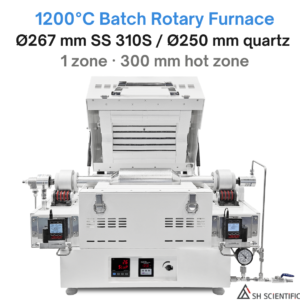
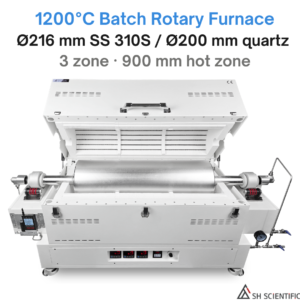
SH Scientific batch rotary tube furnaces use quartz tubes in 120, 200, and 250 mm outside diameter, and stainless steel 310S tubes in 114, 216, and 267 mm. Heating length is either 220 or 870 mm, giving full tube volumes of roughly 2 to 46 liters across the range. Usable powder load sits well below the full volume, because the tube needs open space for material to roll and tumble; fill level, bulk density, and baffle arrangement determine the practical figure.
How do internal baffles and barriers help with fine powders in a rotary furnace?
Baffles lift, fold, and redistribute powder that would otherwise slide along the tube wall as a single mass instead of tumbling. SH Scientific also fits integrated end barriers that keep material inside the hot zone, with openings of 1 mm on stainless steel tubes and 0.5 mm on quartz. Both features matter most for fine, low-density, or highly dispersible materials such as nanotubes, which otherwise migrate toward the tube ends and settle in cold spots.
Can a batch rotary tube furnace run under vacuum or a reactive atmosphere?
Yes, SH Scientific batch rotary tube furnaces use gas-tight sealing rated from 9 to 1,010 Torr, roughly 0.01 to 1.35 bar absolute. That range covers vacuum treatment, inert gas purging, controlled oxidation, and reduction. Optional steam injection from ultrapure water extends the furnace to thermolysis, biochar activation, and selected water-vapor studies. Gas composition, flow rate, working pressure, and exhaust handling are best specified together, because they interact.
When is a 3-zone batch rotary furnace better than single-zone?
Single-zone systems use a 220 mm heating length and suit straightforward recipes at 2 to 12 liters. Three zones extend heating length to 870 mm for volumes up to 48 liters, giving a longer uniform region and staged temperatures along the tube. Choose three zones when the charge is larger than a single zone comfortably handles, or when the recipe calls for a profiled cycle rather than one flat hold.
How is processed powder recovered from a batch rotary furnace after a run?
The process tube slides out of the SH Scientific furnace body, and one end uses a quick-open cap that detaches by hand with no tools or disassembly. Operators can tap the tube to dislodge stuck particles rather than inverting it, which limits loss of valuable powder. Because tubes are interchangeable, a second tube can be loaded while the first is being cleaned, which shortens turnaround between runs.
Quartz or stainless steel tube: which is better for batch powder processing?
Quartz lets operators watch whether powder is tumbling, sliding, or sticking during a run, and avoids metal contact for purity-sensitive chemistry. Stainless steel 310S resists breakage during frequent handling and supports larger loads, which makes it the better choice for routine high-throughput work. SH Scientific offers baffles and barrier systems on both, so mixing and retention behavior is not a trade-off between the two materials.
How fast does the tube rotate in a batch rotary furnace?
SH Scientific batch rotary furnaces rotate from 0 to 10 rpm, adjustable during operation. The correct speed depends on tube diameter, powder volume, particle size, flow behavior, and baffle arrangement: too slow and the bed slides as one mass, too fast and light powder is thrown against the wall instead of tumbling. Variable control lets operators tune movement for each material rather than accepting one fixed rate.
Tell us the material, batch size, temperature, and atmosphere. Our team will recommend a configuration.
Request a quote