Why Keeping the Powder Moving Matters
A powder calcination cycle can reach the programmed temperature and still produce an uneven batch. In a stationary powder bed, material near the tube wall or sample holder may experience different heat and gas exposure from material buried inside the bed. The result can be incomplete conversion, caking, agglomeration, or variation across the batch.
In many cases, the issue is not only the furnace setpoint. It is also how the powder behaves during heating. A rotary tube furnace keeps the material moving, helping more of the powder experience similar thermal and atmospheric conditions.
What Powder Calcination Does
Powder calcination is a controlled heat treatment used to change the physical or chemical properties of a material, typically without melting it.
Depending on the application, calcination can be used to:
- Decompose a precursor
- Remove moisture, solvents, binders, or other volatile compounds
- Form a desired crystalline phase
- Activate a precursor or catalyst
- Prepare a material for coating, oxidation, reduction, or sintering
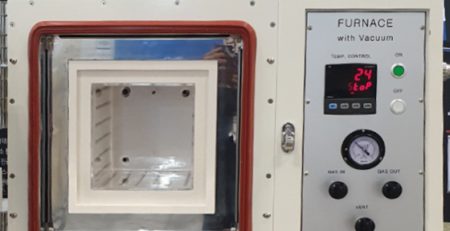
The process may take place in air, oxygen, an inert gas, a reducing gas, or vacuum.
The furnace controller reports the temperature measured at its sensor. It does not show the temperature or gas exposure of every part of the powder bed. Uniform calcination therefore depends on both furnace control and the behavior of the powder inside the tube.
Why Stationary Powder Beds Can Be Difficult
Static tube furnaces are useful for fixed samples, substrates, and many small powder batches. Challenges become more likely as the powder bed becomes deeper, denser, or more prone to bonding.
Particle Bonding and Caking
During heating, particles may soften, react, or form bonds at their contact points. Because the powder remains stationary, weak agglomerates can stay together and develop into larger clumps or a solid cake.
Uneven Heating
Material near the tube wall or sample holder can heat differently from material in the center of the powder bed. Increasing the powder depth or batch size can make these differences more difficult to control.
Limited Gas Penetration
Process gas reaches the exposed powder surfaces first and must then move through the spaces between particles. Dense powder beds and agglomerates can restrict this contact, causing different parts of the batch to experience different atmospheres.
Local Overheating
A stationary portion of the powder may remain near a hotter surface throughout the cycle. This can increase the risk of excessive calcination, grain growth, or partial sintering in that region.
Different Thermal Histories
All of the powder may spend the same number of hours in the furnace, but different regions can reach the target temperature and atmosphere at different times. This can lead to uneven conversion within the same batch.
What Rotation Changes
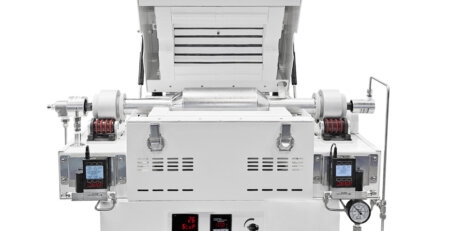
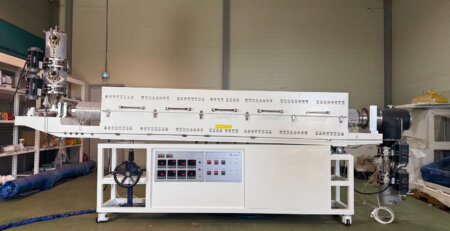
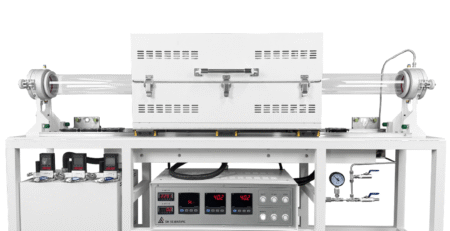
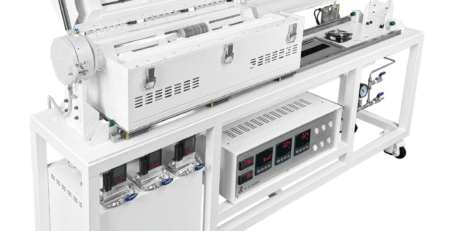
A rotary tube furnace turns the process tube so that the powder can roll and tumble during heating.
Material near the heated wall moves into the powder bed, while material from the interior is brought back toward the surface. When the fill level, rotation speed, and internal design are properly selected, this movement can improve mixing and repeatedly expose new powder surfaces to the process atmosphere.
Rotary processing can provide:
- More consistent heat exposure
- Better contact between the process gas and powder
- Less persistent particle bonding
- Reduced caking and clumping
- More uniform treatment across the batch
- Better repeatability from one run to the next
Internal baffles are especially useful for fine or highly dispersible powders that tend to slide along the tube wall instead of tumbling. The baffles lift, fold, and redistribute the material, creating more effective mixing than rotation alone.
Static Tube Furnace Compared with a Rotary Tube Furnace
| Process factor | Static tube furnace | Rotary tube furnace |
|---|---|---|
| Powder movement | Powder remains in a stationary bed | Powder rolls and tumbles as the tube rotates |
| Mixing | Little or no active mixing | Repeated particle redistribution |
| Heat exposure | Fixed powder positions can maintain temperature differences | Movement can improve exposure uniformity |
| Gas contact | Gas reaches exposed surfaces first | New powder surfaces are repeatedly exposed |
| Agglomeration | Persistent particle contact can promote caking | Motion and baffles can help reduce clumping |
| Best suited for | Fixed samples and shallow powder beds | Powders that benefit from mixed thermal treatment |
The main difference is not simply that one tube rotates. Rotation changes a stationary powder bed into a moving and mixed bed.
Choosing the Right Rotary Furnace
Maximum temperature is important, but it is only one part of furnace selection.
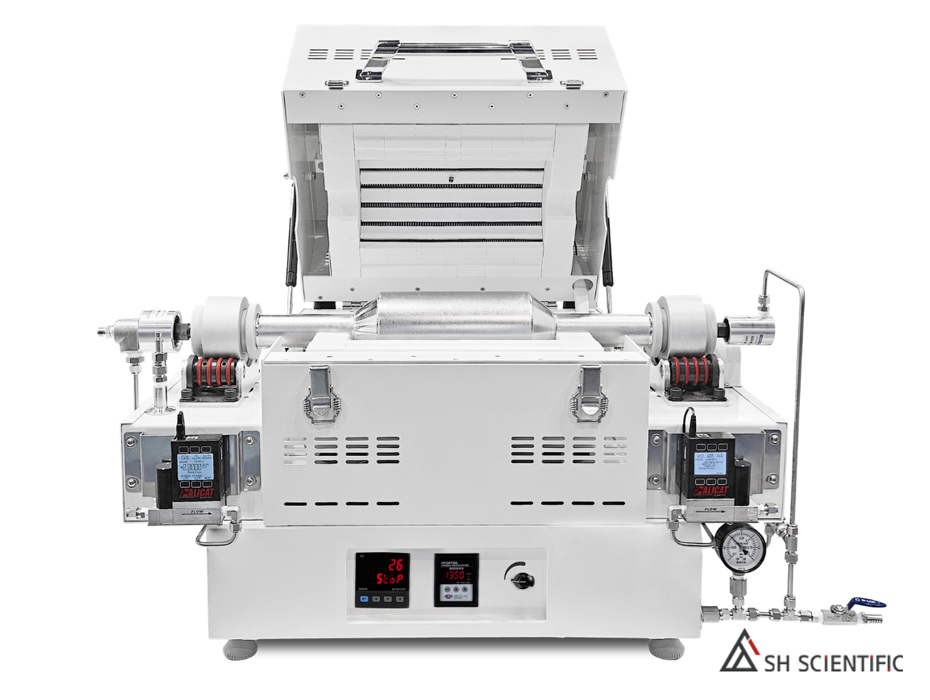
The correct configuration also depends on:
- Powder bulk density and flow behavior
- Tendency to agglomerate or migrate
- Required batch mass and working volume
- Process atmosphere and pressure
- Tube material compatibility
- Required heating length
- Rotation and mixing requirements
- Loading, unloading, and cleaning procedures
SH Scientific offers several tube sizes, heating lengths, and processing capacities so the furnace can be matched to the material and process.
SH Scientific Rotary Furnace Configurations
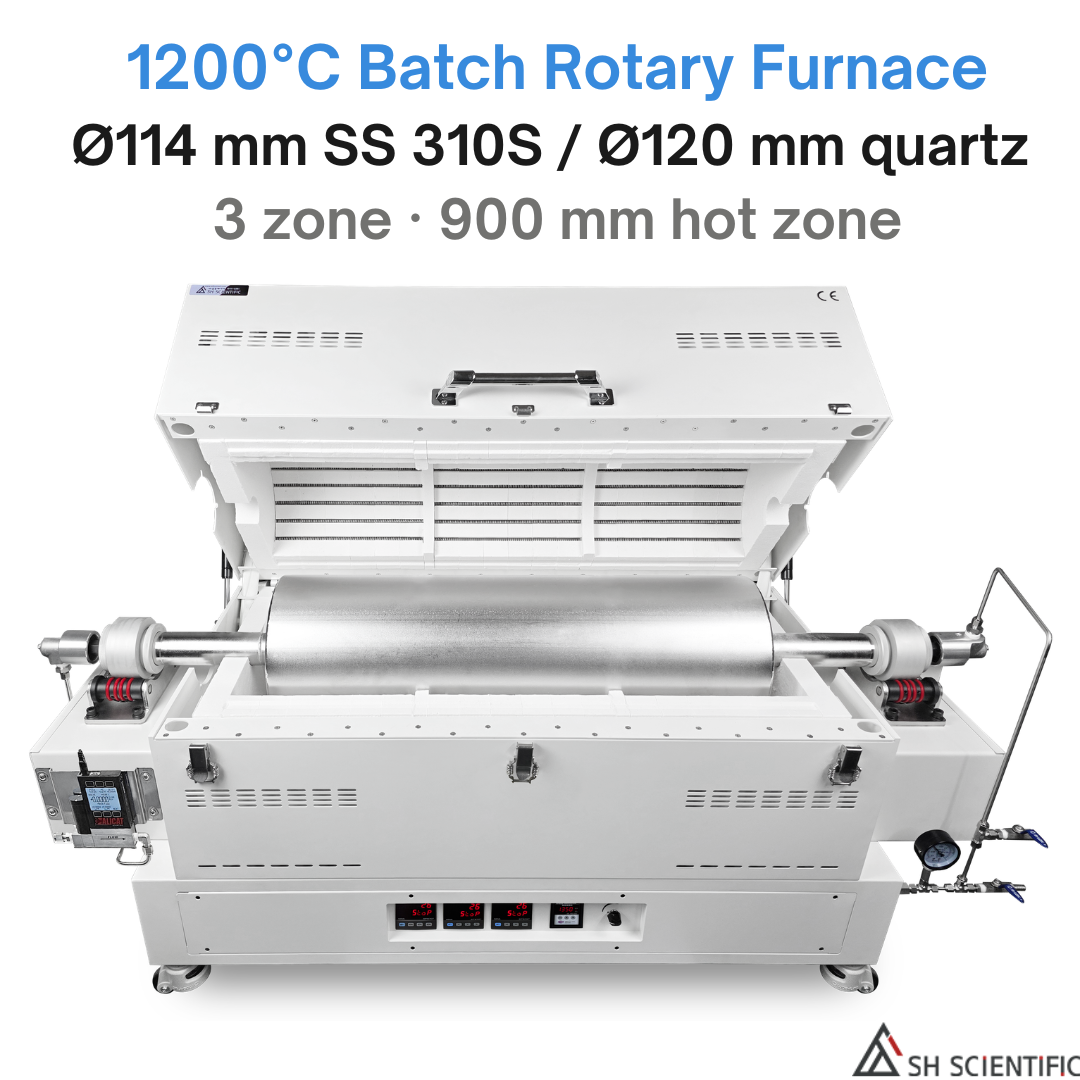
| Parameter | Available options |
|---|---|
| Quartz tube outside diameter | 120, 200, or 250 mm |
| Stainless steel tube outside diameter | 114, 216, or 267 mm |
| Heating length | 220 or 870 mm |
| Tube full fill volume | About 2 to 46 liters |
| Tube rotation | 0 to 10 rpm |
| Operating pressure | 9 to 1,010 Torr, about 0.01 to 1.35 bar absolute |
Capacity note: The listed full tube volume should not automatically be treated as the recommended powder load. The tube needs open space for the material to roll and tumble. Actual working capacity depends on the powder bulk density, fill ratio, baffle design, and flow behavior.
What Sets SH Scientific Rotary Furnaces Apart
Quartz and Stainless Steel Tube Options
Quartz tubes allow the operator to observe the material during processing. This makes it easier to see whether the powder is tumbling, sliding, sticking to the wall, or moving away from the intended processing zone.
Stainless steel tubes provide greater mechanical durability and reduce the risk of breakage during handling compared with quartz. They can be useful for frequent operation and larger powder loads when stainless steel is chemically compatible with the material.
Internal Baffles for More Effective Mixing
Simple tube rotation may not provide enough mixing for every powder.
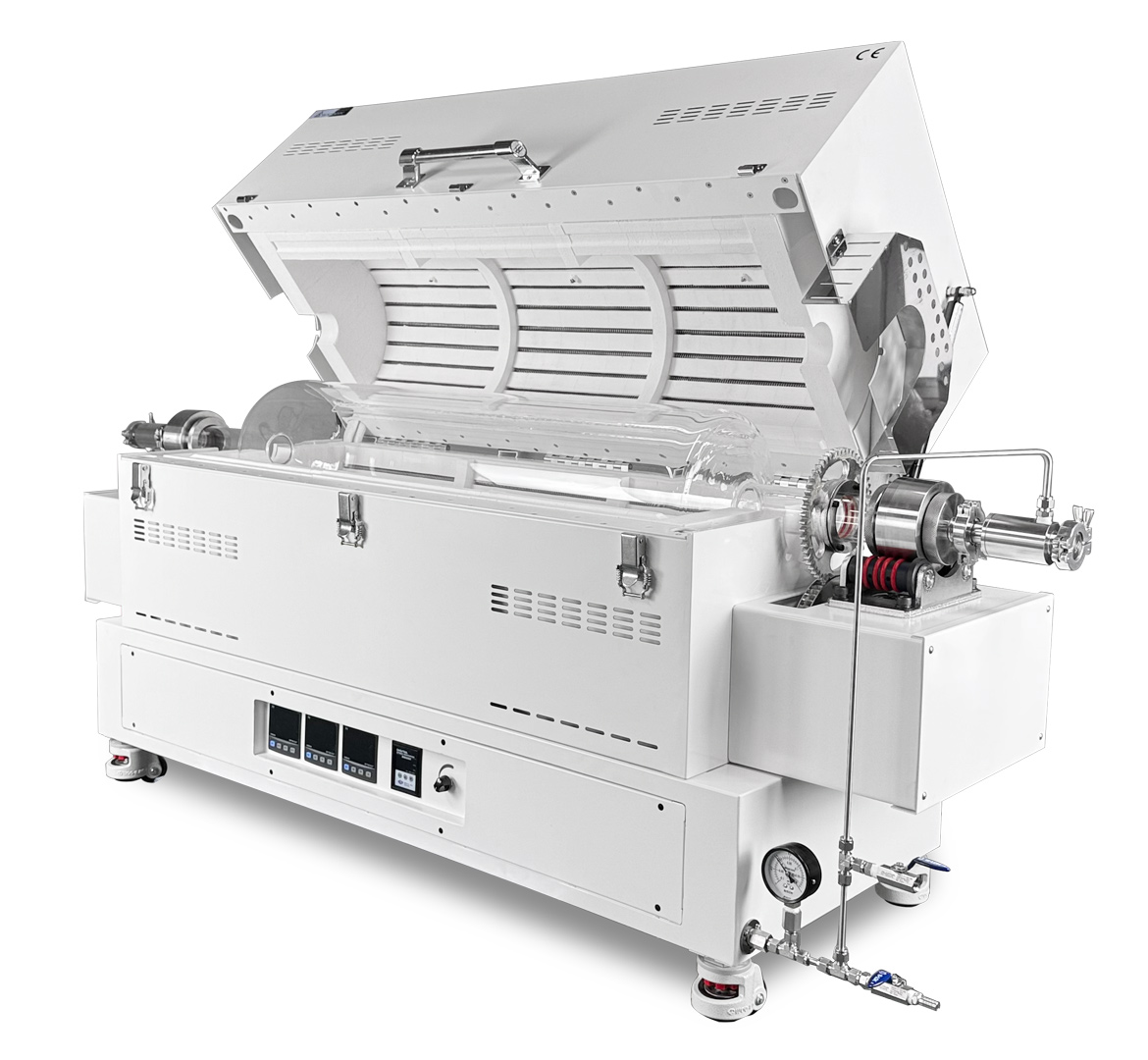
Fine or highly dispersible materials can slide along the tube wall instead of developing a consistent tumbling pattern. Internal baffles lift, fold, and redistribute the powder as the tube turns.
This mixing action helps separate weak agglomerates and improves the movement of material between the tube wall and the center of the powder bed. Baffles are available for both quartz and stainless steel tubes.
Integrated Barriers for Powder Retention
Fine powders can gradually migrate toward the ends of a rotating tube and move outside the controlled hot zone.
SH Scientific’s integrated barrier system is designed to keep the material concentrated within the processing area. The supplied specifications list barrier openings of 1 mm for stainless steel tubes and 0.5 mm for quartz tubes.
The barrier system is particularly useful for fine, low density, or highly dispersible materials that move easily during rotation.
Quick Loading and Material Recovery
Quick open end caps and a tube release design provide direct access for loading, unloading, cleaning, and inspection.
The operator can recover the processed material without inverting the tube or carrying out complex disassembly. This can reduce handling time and help limit the loss of valuable powder.
Gas Tight Sealing
The gas tight sealing system supports operation under vacuum and modest positive pressure.
The stated operating range is 9 to 1,010 Torr, or about 0.01 to 1.35 bar absolute. This allows the furnace to support processes involving vacuum treatment, inert gas purging, controlled oxidation, reduction, and other selected gas environments.
The required gas composition, flow rate, pressure, and treatment of process exhaust should be considered when the system is specified.
Adjustable Tube Rotation
Tube speed can be adjusted from 0 to 10 rpm.
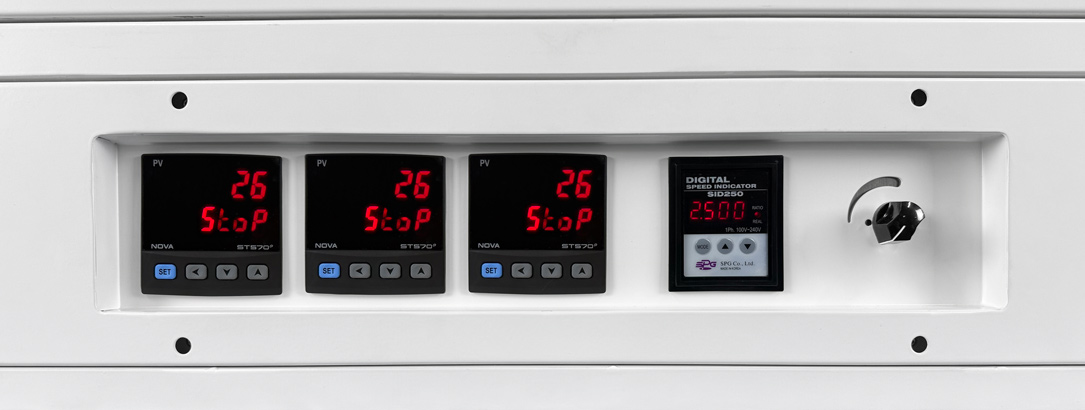
The appropriate speed depends on the tube diameter, powder volume, particle size, flow behavior, and baffle arrangement. Variable speed control allows the operator to tune the powder movement for the specific material instead of relying on one fixed rotation rate.
Optional Steam Injection
An optional steam injection system can introduce water vapor produced from ultrapure water.
Steam can be used for thermolysis research, biochar activation, and selected oxidation or reduction studies that require a controlled water vapor environment.
Applications for Rotary Powder Calcination

Battery Materials
Rotary furnaces can be used for cathode powders, precursor calcination, and related thermal treatments. Continuous powder movement can help improve consistency when phase formation and atmosphere exposure are important to the final material.
Catalyst Processing
Catalyst applications include precursor decomposition, activation, oxidation, and reduction. Tumbling repeatedly exposes powder surfaces to the process gas, supporting more consistent gas and powder interaction.
Carbon Materials
Rotary processing can support biochar activation, carbonization, pyrolysis research, and steam assisted treatment. Controlled atmosphere and optional steam injection allow researchers to study different carbon processing conditions.
Ceramic Powders
Ceramic precursors often require calcination before milling, forming, or final sintering. Rotary movement can help reduce caking and support more consistent precursor conversion before the next processing stage.
Why Powder Movement Matters
A rotary furnace does more than heat a powder. It also controls how the powder moves while it is being heated.
Rotation does not replace careful control of temperature, atmosphere, powder loading, and process time. It addresses another important variable: the behavior of the powder bed itself.
By continuously redistributing the material, a rotary furnace can improve heat exposure, renew contact with the process atmosphere, reduce clumping, and support more consistent calcination.
For battery materials, catalysts, carbon products, and ceramic powders, this can lead to more uniform material and more repeatable processing results.